Introduction
Plant electrophysiology is rapidly emerging as one of the most promising technologies in modern agriculture and horticulture. By measuring electrical signals within plants, it enables continuous, non‑destructive insight into stress, growth conditions, and overall physiological status—often well before visible symptoms appear.
For growers, researchers, and technology providers, this capability supports better crop quality, higher yields, and more efficient use of resources. Yet electrophysiology alone captures only part of the plant’s internal story. Electrical signals reflect integrated responses, not the biochemical mechanisms driving them. To move from interpretation to true precision, plant monitoring must also access the plant’s biochemical and ionic signals.
The Value of Plant Electrophysiology
Plants use internal electrical signalling to sense and respond to their environment. These signals coordinate processes across tissues and organs, providing real‑time insight into how plants are coping with changing conditions.
Three primary categories of electrical signals are widely recognised.
Action Potentials (APs)
Action potentials are fast, transient signals triggered by non‑damaging stimuli such as touch, temperature shifts, or changes in light intensity. They propagate rapidly through plant tissues, enabling immediate, whole‑plant responses.
Variation Potentials (VPs)
Variation potentials arise from damaging events such as wounding, burning, or herbivory. These signals are longer‑lasting and can influence photosynthesis, respiration, and defence‑related gene expression.
System Potentials (SPs) / Electric Potentials (EPs)
System or electric potentials are lower‑amplitude signals associated with environmental variables including:
- Water availability
- Light intensity
- Humidity
- Temperature
- Nutrient status
These signals often follow circadian rhythms and are closely linked to plant water balance and photosynthetic activity.
✅ Together, APs, VPs, and SPs form the foundation of plant electrophysiology, making it a powerful monitoring tool—particularly in controlled environments such as greenhouses and vertical farms.
The Missing Layer: Direct Biochemical Information
While electrophysiology can reliably indicate that a plant is under stress, it does not always reveal why. Different stressors—such as drought, salinity, nutrient deficiency, hypoxia, or oxidative stress—can produce similar electrophysiological patterns.
Inside the plant, however, these stresses are mediated by specific biochemical and ionic pathways, including changes in:
- Glucose and other sugars – energy status and carbon allocation
- Oxygen – root and tissue hypoxia
- Reactive oxygen species (ROS) – early stress signalling and damage responses
- Sodium (Na⁺) and chloride (Cl⁻) – salinity stress
- Calcium (Ca²⁺) – a universal secondary messenger
- Nitrate (NO₃⁻) and ammonium (NH₄⁺) – nitrogen uptake and metabolism
🔬 Access to these parameters provides direct, actionable insight into plant physiology, rather than indirect inference from electrical behaviour alone.
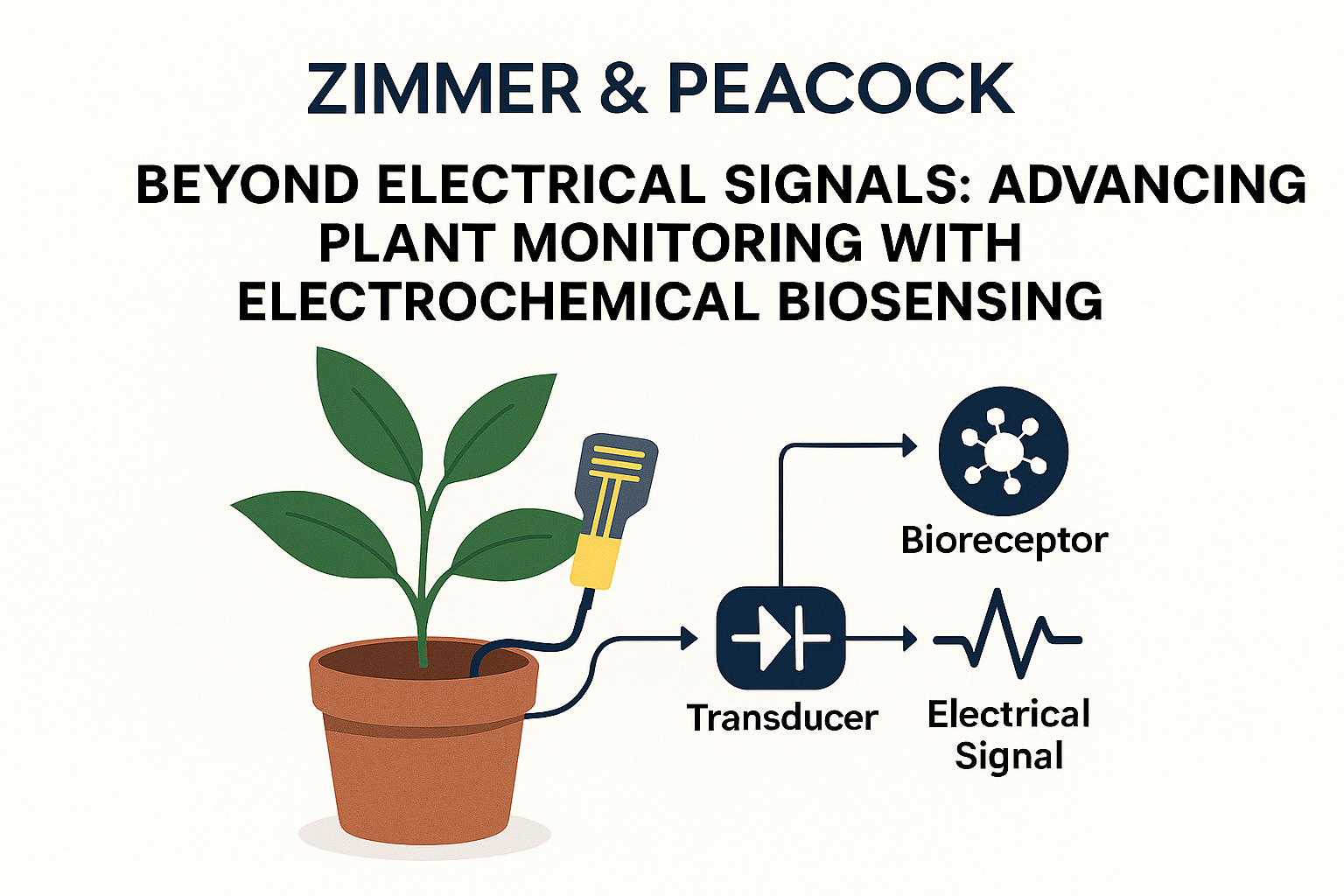
Electrochemical Biosensing: Enabling the Next Generation of Plant Monitoring
Electrochemical biosensing is uniquely suited to extracting biochemical and ionic information from biological systems. It offers:
- High sensitivity
- Strong analyte specificity
- Compatibility with continuous, in‑situ monitoring
These characteristics make electrochemical biosensing a natural complement to plant electrophysiology.
At Zimmer & Peacock (ZP), the focus is not on delivering complete agronomy platforms or advisory services. Instead, ZP specialises in contract development and contract manufacturing (CDMO) of electrochemical sensors—enabling others to build advanced plant‑sensing technologies.
What ZP Delivers
⚙️ ZP supports plant and agricultural sensing innovators by providing:
- Sensor formulation development for specific analytes
- Custom electrode designs and tailored surface chemistries
- Scalable manufacturing, from early prototypes to commercial volumes
- Consistent, high‑quality sensor production for seamless system integration
ZP’s electrochemical sensors are already used to detect a wide range of biologically relevant molecules and ions. These same capabilities can be applied directly to phyto‑biosensing, whether sensors are embedded in:
- Plant probes
- Soil monitoring systems
- Irrigation hardware
- Hybrid platforms combining electrophysiology and biosensing
For an overview of existing sensing capabilities, see:
👉 https://shop.zimmerpeacock.com/en-gb/pages/sensors
From Signals to Systems
💡 Plant electrophysiology tells you when a plant is under stress.
💡 Electrochemical biosensing tells you why.
The future of plant monitoring lies in integrated systems that combine:
- Electrical signalling for early warning and systemic context
- Biochemical sensing for specific diagnosis and quantification
Such hybrid approaches enable higher confidence decision‑making, more precise interventions, and better outcomes across research, controlled‑environment agriculture, and field applications.
ZP’s role is to enable this transition by delivering sensor technologies that are commercially viable, scalable, and reliable.
Practical Takeaways
📌 What this means in practice:
- Electrophysiology is an excellent early‑warning tool, but not a standalone diagnostic
- Biochemical and ionic sensing adds specificity and actionable insight
- Combining electrical and electrochemical data supports precision agriculture and advanced research
- Robust sensor design and manufacturing are critical for real‑world deployment
Work With ZP
If your organisation is developing plant, soil, or agricultural sensing technologies and requires:
- Custom electrochemical sensor development
- Robust, production‑ready sensor manufacturing
- A long‑term CDMO partner with deep sensing expertise
we invite you to speak with our team.
👉 Contact us: https://www.zimmerpeacock.com/contact
👉 Explore sensor formulations and capabilities: https://shop.zimmerpeacock.com/en-gb/pages/sensors
Plants are complex biological systems. Turning their internal chemistry into usable data requires precision engineering, robust manufacturing, and specialist expertise. That is where ZP fits.
Optional hashtags:
#Electrochemistry #Biosensors #PlantScience #PrecisionAgriculture #ScientificInstrumentation #AgriTech
