Continuous monitoring only works if people can actually wear the device—comfortably, safely, and for extended periods. ZP's IP portfolio addresses this often-overlooked challenge and forms an important layer of ZP’s wearable microneedle IP moat by protecting how microneedle sensors actively manage moisture and skin irritation during long-term wear.
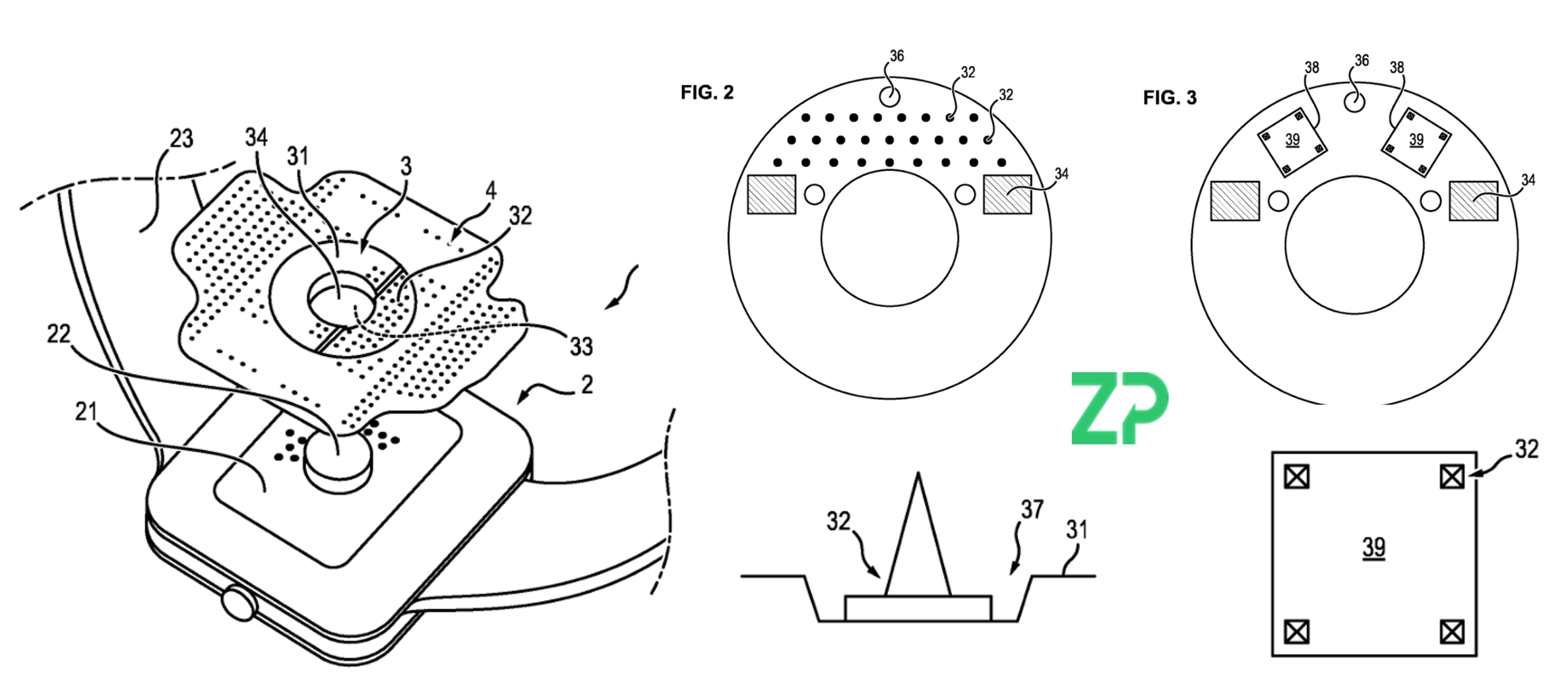
The patent covers a wearable microneedle sensor that integrates small, biocompatible moisture-absorbing pads placed close to the microneedles on the skin-facing surface of the device. When worn for several days, moisture naturally builds up under patches and around microneedles due to sweat and limited airflow. This humidity is a major driver of skin irritation, discomfort, and bacterial growth—and a key reason why many wearable sensors must be replaced frequently.
ZP’s approach is straightforward but powerful: instead of trying to seal moisture out entirely, the sensor locally absorbs and regulates it. The absorbent pads are positioned just millimetres from the microneedles—close enough to keep the sensing area dry, but without interfering with microneedle insertion or biochemical measurement. Optional micro-air channels further improve airflow while remaining compatible with water exposure.
The result is a microneedle system that remains dry, comfortable, and hygienic over prolonged wear, allowing users to keep the same sensor in place for longer periods without irritation. This directly improves user experience, reduces replacement frequency, and supports more reliable continuous data collection.
Within ZP’s broader wearable microneedle portfolio, this patent strengthens the IP moat at the human-interface layer. It complements patents covering microneedle fabrication, insertion mechanics, biochemical sensing, dynamic range, electrical connectivity, mechanical compliance, and data fusion. Together, these layers protect not only how ZP measures physiology—but how those measurements can be delivered day after day on real human skin.
For partners and collaborators, this capability translates into a decisive advantage: wearable microneedle platforms that are not only accurate and manufacturable, but also designed for real-world wearability, backed by a deep, system-level IP moat that is difficult to replicate.