Introduction
Dielectrophoresis (DEP) is a widely used technique for manipulating and separating particles within microfluidic systems using electric fields rather than mechanical structures or chemical labels. It is particularly valuable where subtle differences in particle size or electrical properties can be exploited to achieve controlled sorting.
This article explains the fundamentals of dielectrophoretic separation and sorting, focusing on how particle polarisation, electric field gradients, and microfluidic flow geometry combine to enable selective particle deflection. The discussion is grounded in practical engineering considerations relevant to researchers and device designers working with electrodes, fluids, and microscale systems.
Dielectrophoresis: The Core Principle
🔬 Dielectrophoresis refers to the motion of electrically neutral particles in a non‑uniform electric field.
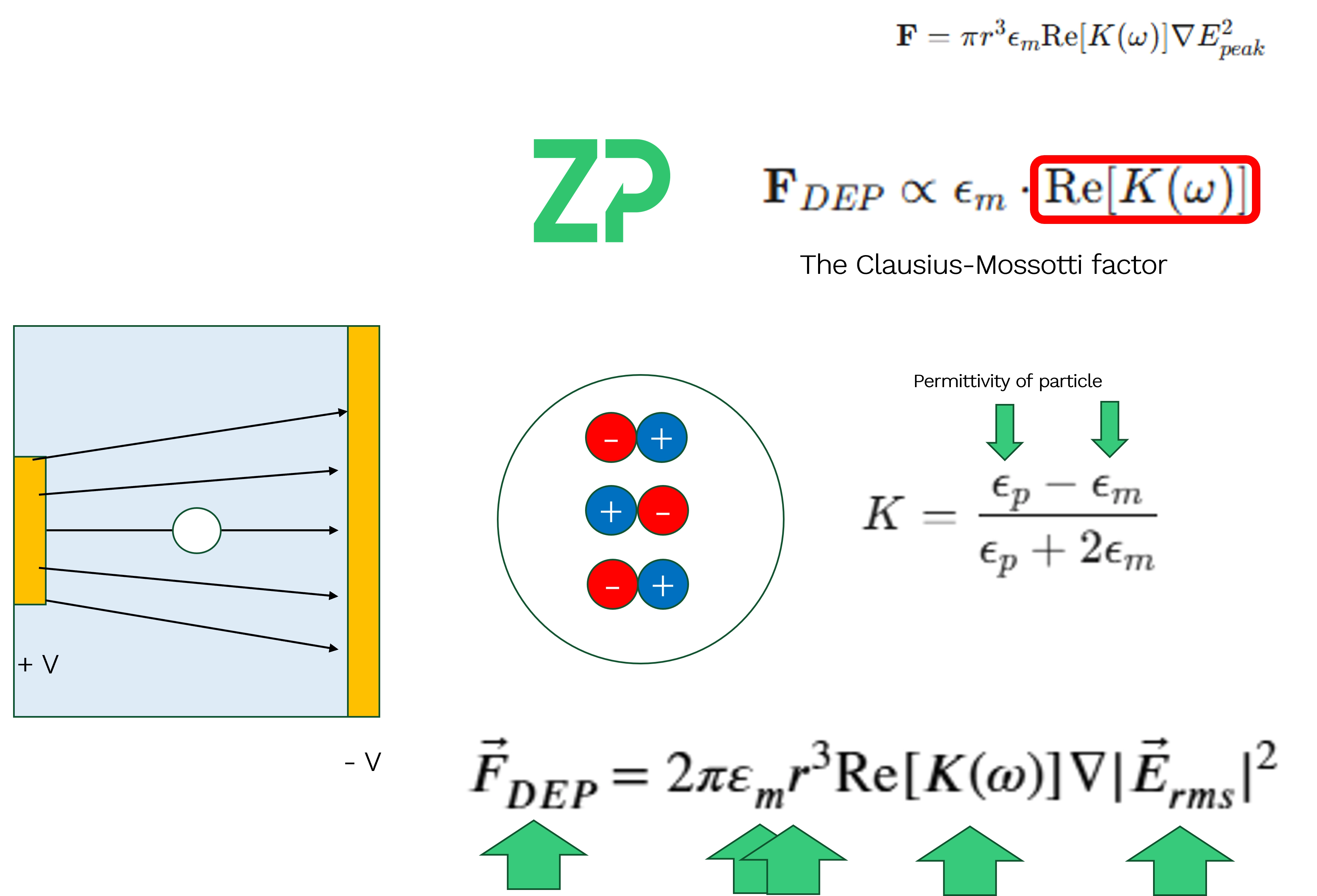
Although the particles carry no net charge, applying a potential across electrodes induces a redistribution of charge within the particle. This creates a dipole moment, allowing the particle to interact with the electric field gradient and experience a net force.
Key characteristics of DEP include:
- Particles do not need to be charged
- Motion depends on field gradients, not simply field strength
- The response depends on particle size and material properties
This makes DEP especially suitable for microfluidic environments, where electric fields can be precisely controlled.
Microfluidic Flow and Sorting Junctions
In a typical microfluidic sorting design:
- Fluid enters through a single inlet
- The channel geometry creates a dominant (major) flow path and a secondary (minor) path
- In the absence of an electric field, particles follow the region of highest flow velocity
⚙️ When a pair of electrodes is placed across a junction and a voltage is applied, a local electric field is established. This field introduces an additional force acting on particles as they pass through the junction.
How Particle Size Enables Separation
📌 A critical factor in dielectrophoretic sorting is particle size.
Both small and large particles become polarised in the electric field. However, the force they experience differs significantly because the DEP force scales with the cube of the particle radius (R³).
This has important consequences:
- Small particles may polarise but remain dominated by fluid flow
- Larger particles experience a much stronger force and can be deflected into an alternative channel
Even a modest increase in particle radius can lead to a large increase in force, enabling effective size‑based separation within the same device.
The Role of Permittivity and the Medium
DEP behaviour is not governed by particle size alone. The electrical properties of both the particle and the surrounding medium are equally important.
Most microfluidic systems use aqueous buffers, whose permittivity strongly influences particle response. The DEP force depends on the difference between:
- The permittivity of the particle
- The permittivity of the medium
The Clausius–Mossotti Factor
💡 This relationship is captured by the Clausius–Mossotti factor, which determines both the magnitude and direction of the DEP force.
A larger contrast between particle and medium permittivity increases the likelihood of effective separation. Careful choice of buffer composition can therefore enhance sorting performance.
Voltage as a Control Lever
⚡ The applied voltage plays a dominant role in DEP‑based systems.
The dielectrophoretic force depends on the square of the applied voltage, meaning:
- Small increases in voltage can produce large changes in force
- Voltage is one of the most sensitive parameters in system tuning
However, higher voltages must be balanced against considerations such as heating, electrochemical stability, and electrode durability.
Engineering Implications for DEP Systems
✅ Effective dielectrophoretic sorting relies on the combined optimisation of:
- Channel geometry and flow profiles
- Electrode placement and materials
- Applied voltage and field gradients
- Medium composition and particle properties
From an engineering standpoint, DEP highlights the importance of understanding interactions between electrodes, liquids, and particles at the microscale.
At Zimmer & Peacock, this intersection is a core area of expertise, particularly in the design and manufacture of screen printed electrodes for electrochemical and microfluidic applications.
For projects requiring reliable and reproducible electrode platforms, bare screen printed electrodes provide a flexible foundation for experimental and applied DEP systems:
https://shop.zimmerpeacock.com/en-gb/collections/bare-electrodes
Practical Takeaways
📌 Key Insights for Researchers and Engineers
- DEP enables label‑free particle sorting in continuous flow
- Particle size has a strong, cubic influence on force
- Permittivity contrast between particle and medium is critical
- Voltage is a highly effective but sensitive tuning parameter
- Electrode design underpins performance and reproducibility
Closing Thoughts
Dielectrophoretic separation offers a powerful and elegant approach to particle manipulation in microfluidic devices. When flow dynamics, electric fields, and material properties are aligned, DEP enables precise, scalable sorting without complex mechanical components.
For those exploring DEP‑based designs, electrode integration, or electrochemical interactions in microscale systems, informed discussion and collaboration often unlock better solutions.
If you would like to explore ideas or discuss technical challenges, you are welcome to get in touch:
https://www.zimmerpeacock.com/contact https://shop.zimmerpeacock.com/en-gb/collections/bare-electrodes
Optional Hashtags
#Dielectrophoresis #Microfluidics #Electrochemistry #ParticleSorting #ScientificInstrumentation #ResearchAndDevelopment
