Introduction
Electroosmotic flow (EOF) is a foundational phenomenon in electrochemistry and microfluidics that enables liquid motion without mechanical pumps or pressure gradients. Instead, EOF exploits the interfacial electrostatics that arise when an electrolyte contacts a charged solid surface. For engineers and researchers working with capillaries, microchannels, and electrochemical devices, understanding EOF is critical—not only for avoiding unintended flow artefacts, but also for deliberately designing systems that use electric fields to move solutions in a controlled and predictable way.
This article explores electroosmotic flow through the lens of the electrical double layer, translating core physical concepts into practical engineering insight relevant to analytical chemistry, biosensing, and electrochemical device development.
Electroosmotic Flow as an Electrochemical Pump
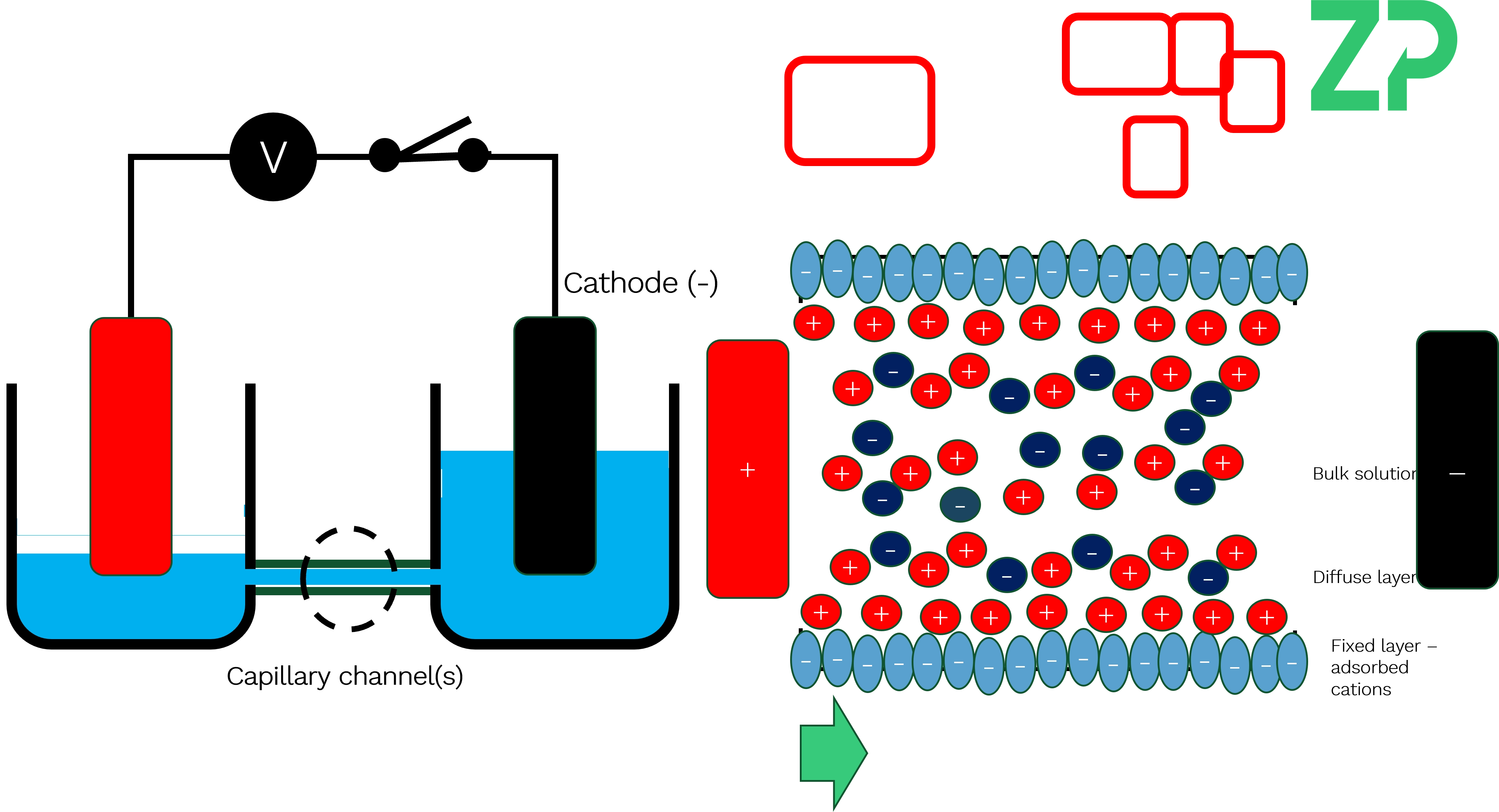
At its simplest, an electroosmotic system consists of two reservoirs connected by a narrow channel or capillary. An electrode is placed in each reservoir—one acting as an anode, the other as a cathode—and a voltage is applied across the system.
⚙️ What matters here is not the electrode material or redox chemistry, but the electric field established along the channel. Under the right conditions, this field causes the entire liquid column to move, effectively turning the channel into an electroosmotic pump.
A narrow capillary geometry is deliberate. Electroosmotic flow is most efficient when surface effects dominate, which is exactly the case in small‑diameter channels commonly used in microfluidics and analytical instrumentation.
Charged Channel Walls and the Electrical Double Layer
The origin of electroosmotic flow lies at the solid–liquid interface.
Surface Charge in Silica Capillaries
In aqueous systems using glass or silica channels:
- At neutral to alkaline pH, silica surfaces become deprotonated
- This creates a net negative charge on the channel walls
- The magnitude of this surface charge is often expressed as the zeta potential
🔬 Silica is therefore not an inert container—it actively structures the solution adjacent to it.
Ion Organisation Near the Surface
When an electrolyte such as sodium chloride is present, ions rearrange themselves in response to the surface charge:
Absorbed (fixed) layer
Cations accumulate directly at the negatively charged wall.Diffuse layer
A region with a slight excess of cations over anions, extending into the solution.Bulk solution
Electrically neutral, with balanced concentrations of cations and anions.
Together, these regions form the electrical double layer, which is central to electroosmotic behaviour.
How an Applied Voltage Generates Flow
Once the electrical double layer is established, applying a voltage along the channel produces motion.
📌 The key mechanism is simple but powerful:
- Cations in the absorbed layer experience an electrostatic force
- They migrate toward the cathode
- Their movement drags the diffuse layer with them
- Viscous coupling pulls the bulk solution along
The result is bulk liquid flow along the channel. In typical aqueous silica systems, this flow proceeds from anode to cathode, though the direction can reverse depending on surface chemistry and electrolyte composition.
💡 Unlike pressure‑driven flow, electroosmotic flow tends to exhibit a relatively uniform velocity profile across the channel, which is advantageous for analytical reproducibility.
Factors That Control Electroosmotic Flow Velocity
The velocity of electroosmotic flow is governed by a small number of well‑defined physical parameters.
Permittivity of the Solvent
- Water has a high relative permittivity (≈80)
- Methanol is significantly lower (≈33)
All else being equal, aqueous systems therefore support substantially higher electroosmotic velocities than many organic solvents.
Zeta Potential of the Channel Wall
- Silica typically exhibits zeta potentials on the order of tens to around 100 mV
- Strongly influenced by pH and surface treatment
Higher absolute zeta potential leads directly to stronger electroosmotic flow.
Viscosity of the Solution
- Flow velocity is inversely proportional to viscosity
- Low‑viscosity fluids (e.g. water) flow readily
- Highly viscous fluids dramatically suppress EOF
This relationship is intuitive but critical when working with complex or biologically relevant solutions.
Applied Electric Field
- Increasing the applied potential increases flow proportionally
- Enables precise electronic control of fluid movement
✅ This linear dependence makes EOF particularly attractive for integrated electrochemical systems.
Why Electroosmotic Flow Matters in Electrochemical Devices
Electroosmotic flow is not just a laboratory curiosity—it has direct implications for real‑world systems.
Practical Advantages
✅ No moving parts
✅ No pressure gradients
✅ Smooth, predictable flow profiles
✅ Excellent compatibility with microscale geometries
In electrochemical platforms, EOF allows electrodes to do more than drive redox reactions—they can actively control solution transport within the device.
Design Implications
📌 Channel material and surface chemistry are as important as electrode placement
📌 pH control directly affects flow behaviour
📌 Fluid selection influences both speed and stability
📌 Electrical control enables integration with sensing and actuation
For developers of biosensors, analytical cartridges, and lab‑on‑chip systems, EOF can be either a powerful tool or a hidden variable—depending on whether it is understood and engineered deliberately.
Key Insights and Takeaways
What This Means in Practice
- Electroosmotic flow arises directly from the electrical double layer
- Charged channel walls structure the solution even before voltage is applied
- Applying an electric field converts this interfacial structure into bulk motion
- Flow velocity depends on permittivity, zeta potential, viscosity, and voltage
- EOF enables pump‑free fluid transport in electrochemical and microfluidic devices
💡 Mastery of these principles allows engineers and researchers to design systems where electrical inputs control both chemistry and fluid mechanics simultaneously.
Closing Thoughts
Electroosmotic flow illustrates how fundamental electrochemical physics translates into practical device functionality. By understanding the electrical double layer and its interaction with applied electric fields, it becomes possible to move liquids with precision—without mechanical complexity.
For teams working at the interface of electrochemistry, materials science, and device engineering, these concepts provide a foundation for more integrated, reliable, and scalable systems.
If you would like to explore how these physical principles can be applied within real electrochemical platforms or product development workflows, discussion and collaboration are always welcome.
👉 https://www.zimmerpeacock.com/contact 👉 https://shop.zimmerpeacock.com/en-gb/collections/bare-electrodes
