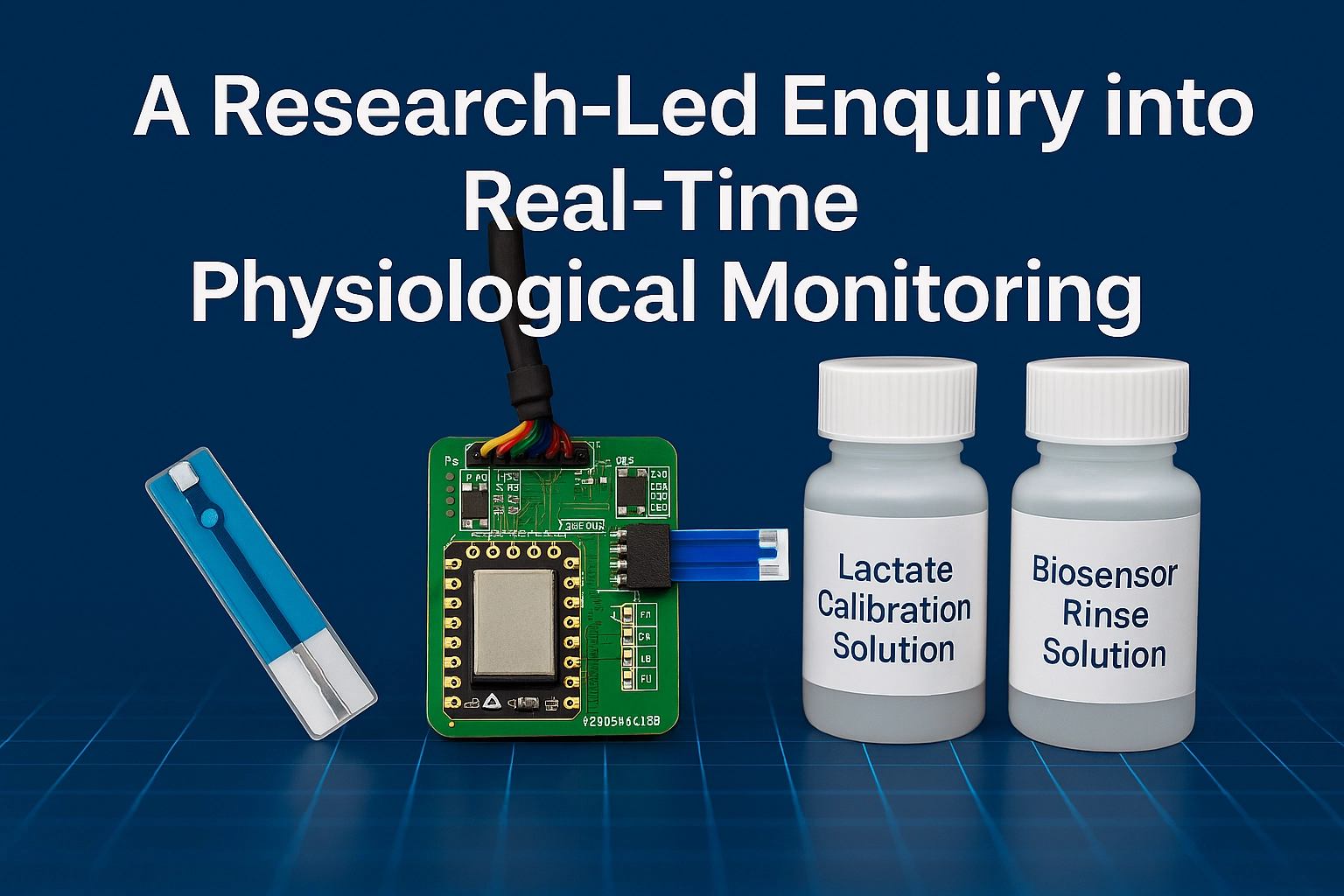
Background: A Research‑Led Enquiry into Real‑Time Physiological Monitoring
A European clinical research team specialising in sports science and physiotherapy recently contacted Zimmer & Peacock with an ambitious technical challenge: developing real‑time physiological monitoring for extreme endurance motorsport environments, such as long‑duration off‑road rallies.
The team’s interest centred on wearable biosensing technologies capable of continuously measuring biomarkers including:
- Lactate
- Glucose
- Electrolytes such as sodium and potassium
Their ultimate goal was to access open, real‑time physiological data to support research, performance optimisation and athlete safety in harsh conditions involving heat, vibration and prolonged exertion.
Translating an Ambitious Concept into a Practical Starting Point
While the long‑term vision involved advanced wearable platforms, the immediate challenge was more fundamental:
How can a research team practically validate whether electrochemical biosensing is viable for their application before committing to full product development?
Zimmer & Peacock’s response focused on enabling a proof‑of‑principle at Technology Readiness Level (TRL) 3, where experimental concepts are validated in a laboratory environment.
What’s Required for a TRL‑3 Proof‑of‑Principle?
To demonstrate feasibility at this early stage, four core components are required. Used together, they allow researchers to generate meaningful electrochemical data without unnecessary system complexity.
1. Biosensor
A disposable electrochemical sensor provides the biochemical interface. For lactate monitoring, a suitable example is:
This sensor enables researchers to characterise response, sensitivity and repeatability under controlled conditions.
2. Electronics
Dedicated electronics are required to bias the sensor correctly and acquire high‑quality signals.
This approach removes the need for custom electronics design during early experimentation.
3. Test Solution
Calibration and validation require known concentrations of the target analyte.
Using traceable test solutions allows teams to establish sensor performance metrics before moving toward biological samples.
4. Rinse Solution
To enable repeated measurements and extend sensor usability during testing:
This supports efficient laboratory workflows and reduces consumable waste during feasibility studies.
Why Start at TRL‑3?
For research teams working at the intersection of physiology, engineering and wearable technology, TRL‑3 offers several advantages:
- Low development risk – validate sensing principles before investing in form factor or integration
- Rapid iteration – quickly compare biomarkers, enzymes or electrochemical approaches
- Data transparency – full access to raw signals for algorithm development
- Clear progression path – results directly inform later wearable or microneedle designs
A well‑executed proof‑of‑principle saves time, budget and technical risk further down the development pipeline.
From Laboratory Validation to Wearable Systems
Although the initial discussion focused on lactate sensing, the same modular approach can be extended to other biomarkers relevant to endurance and heat stress research, including glucose and electrolytes.
Once feasibility is established, research teams can then evaluate:
- Sensor miniaturisation
- Integration into patches, wearables or microfluidic systems
- Real‑time data transmission and analytics
- Field testing under realistic environmental conditions
Key Takeaway
Early‑stage biosensing projects do not require fully integrated wearables to begin generating value. By combining off‑the‑shelf sensors, dedicated electronics and validated test solutions, research teams can rapidly confirm whether a sensing approach is suitable for their application — even in demanding use cases such as extreme endurance sport.
This structured path from enquiry to proof‑of‑principle highlights how modular electrochemical platforms can support innovation long before final product design begins.


