One of the hardest challenges in wearable microneedle technology is balancing three competing demands: reliable signal quality, minimal pain, and long-term wearability. Zimmer and Peacock's IP sits at the heart of the solution to this problem, protecting a fundamentally different way of designing microneedle sensors for continuous body monitoring.
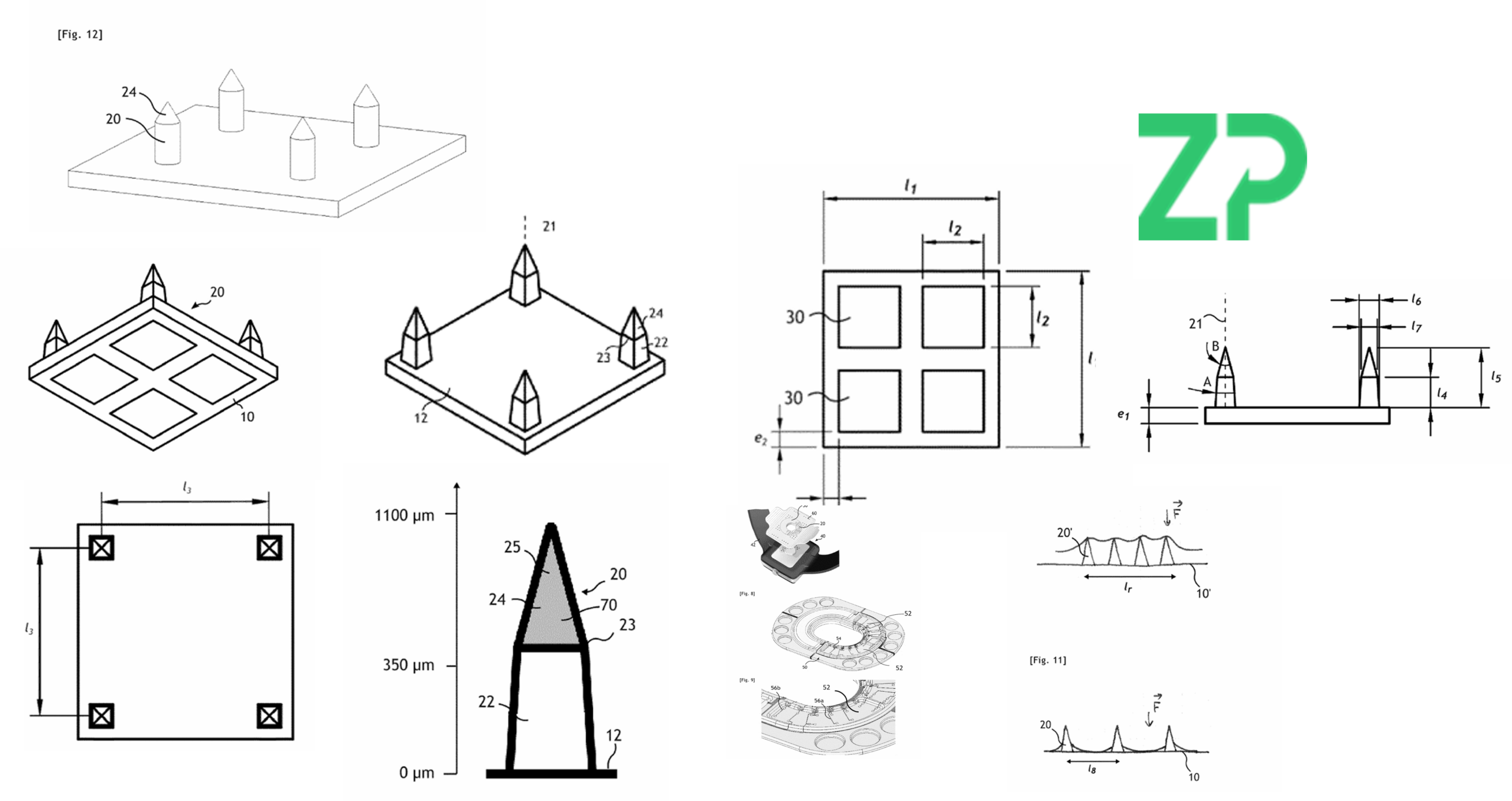
Rather than relying on dense arrays of dozens or hundreds of microneedles, this invention shows that fewer, carefully engineered microneedles can perform better. By spacing microneedles at least one millimetre apart—and often more—the design avoids the so-called “fakir effect,” where closely packed needles deform the skin and cause pain instead of penetrating cleanly. The result is a system that can be applied gently, often by hand or through normal attachment of the wearable, without the need for spring-loaded applicators.
The patent also covers a distinctive microneedle geometry, where a narrow penetration tip is combined with a larger active sensing surface positioned at the optimal depth beneath the skin. This geometry maximises signal strength from interstitial fluid while minimising discomfort and tissue disruption. Because each microneedle delivers a stronger, cleaner signal, the system can operate with far fewer needles—improving comfort, reducing manufacturing complexity, and increasing reliability.
Within ZP’s broader wearable microneedle portfolio, this patent is foundational. It underpins IP covering capsules, patches, electrodes, signal processing, multi-analyte sensing, and wrist-worn form factors, and it directly supports ZP’s ability to deliver continuous monitoring without compromising user experience. Importantly, it also enables modular designs where sensing performance, comfort, and mechanical attachment are engineered together rather than traded off against each other.
For ZP’s partners, this patent is not just about microneedle shape or spacing. It is part of a system-level IP moat that protects how wearable microneedle devices are applied, worn, and trusted in everyday life. By embedding these patented principles into client projects, ZP helps collaborators build differentiated products that combine clinical-grade data quality with true real-world wearability.