One of the fundamental challenges in continuous biomarker monitoring is not access to the body—but accuracy across the full range of real-world physiology. Biomarkers such as glucose, lactate, or ketones do not vary within a narrow band. They span very different concentration ranges depending on whether a user is in a normal, stressed, or pathological state. A single sensor optimised for one range often loses precision at the extremes. This is the problem addressed by WO 2022/136785, one of the key patents underpinning ZP’s wearable microneedle IP moat.
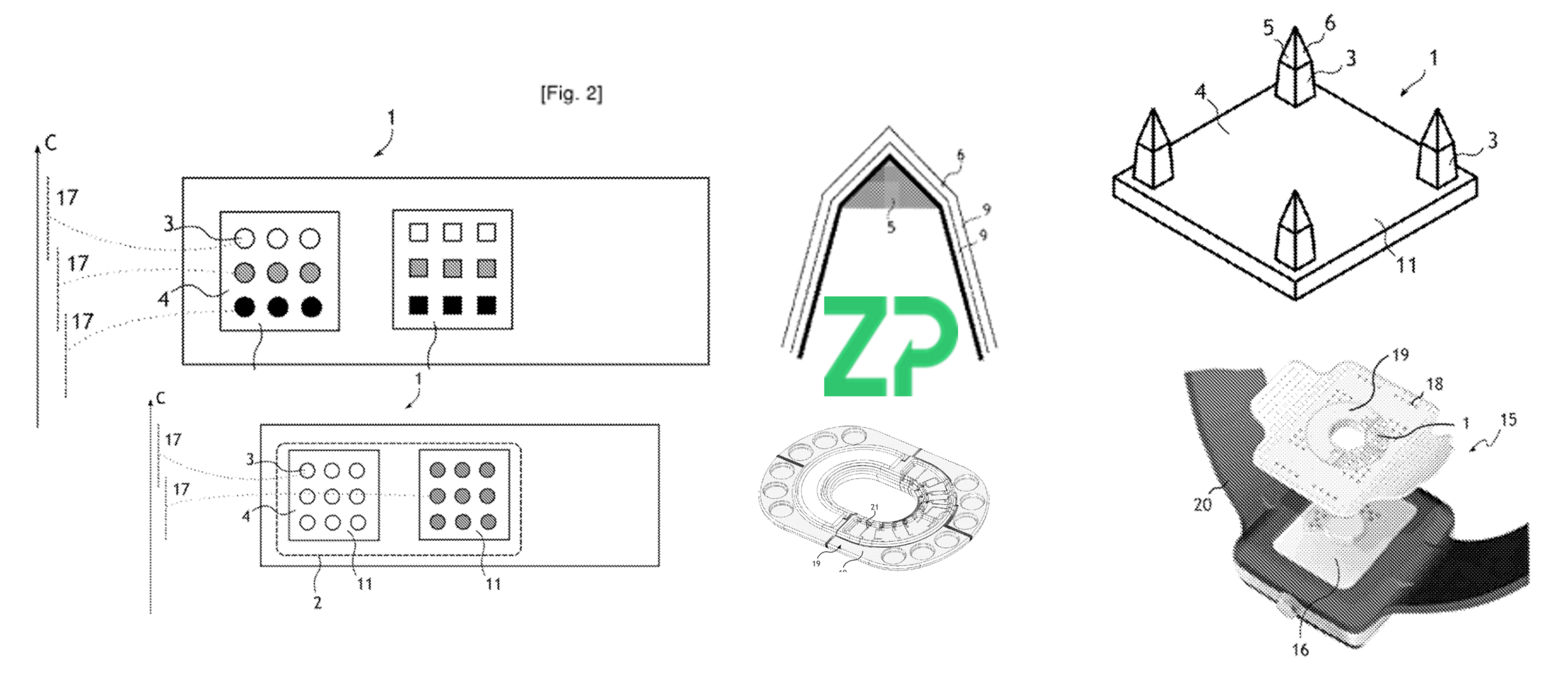
This invention protects a microneedle sensor architecture in which multiple microneedles measure the same biomarker, but each is tuned to a different concentration range. Instead of changing microneedle geometry—which is difficult and costly to manufacture—ZP’s approach varies only the biochemical coating on the microneedles. By adjusting enzyme type, layer structure, or molecular density, each microneedle responds optimally to a specific physiological range.
In practical terms, this means a single wearable patch can simultaneously measure low, normal, and high concentrations of the same analyte using microneedles that are geometrically identical and inserted to the same depth. The device automatically benefits from high sensitivity during hypoglycaemia, stable accuracy during normal conditions, and reliable readings during hyperglycaemia—or equivalent states for lactate or ketones—without changing hardware.
The patent also covers modular manufacturing strategies, where microneedles with different coatings are produced separately and then assembled onto a common support. This significantly simplifies industrialisation while preserving tight control over biochemical performance. The result is a scalable platform that combines manufacturing efficiency with clinical robustness.
Within ZP’s broader wearable microneedle portfolio, this patent strengthens the IP moat at the biochemical signal-conditioning layer, complementing other ZP patents that protect microneedle insertion, adhesion, electrical connectivity, mechanical stability, and wearable integration. Together, these inventions secure not just access to interstitial fluid, but accurate sensing across the full spectrum of human physiology.
For partners working with ZP, this capability translates into a powerful advantage: wearable microneedle systems that remain precise as the user’s condition changes, protected by a system-level IP moat that is difficult to design around and straightforward to deploy in real-world products.