From Signals to Solutions: A Live Demo of Modern Electrochemistry
Ever wondered how a complex electrochemical technique translates into a simple, actionable result? In a recent webinar, we moved beyond theory to show how modern potentiostats and smart data processing can turn intricate voltammograms into clear, quantitative answers—like the caffeine in your Red Bull or the spiciness of your Tabasco sauce.
This blog breaks down the key moments, live demos, and major takeaways from the session.
The Philosophy: From Complex Data to Simple Answers
The webinar focused on a core principle: the goal of applied electrochemistry is commercialization and usability. This means developing assays that are fast, simple, and user-friendly. The end-user—a doctor, a food scientist, an environmental engineer—doesn't care about the beautiful waveform; they care about the concentration number.
A user-friendly potentiostat was demonstrated that automatically streams data to a cloud platform ("Djuli") for instant processing and analysis, embodying this philosophy.
The Big Idea: The Electrochemist as a Data Scientist
The core message was a shift in mindset: Modern electrochemists are data scientists. The real value isn't in running a perfect cyclic voltammogram; it's in the data pipeline that transforms that raw data into a meaningful result. As the host put it:
"Nobody really likes your electrochemical data. They only want numbers... meaning concentration."
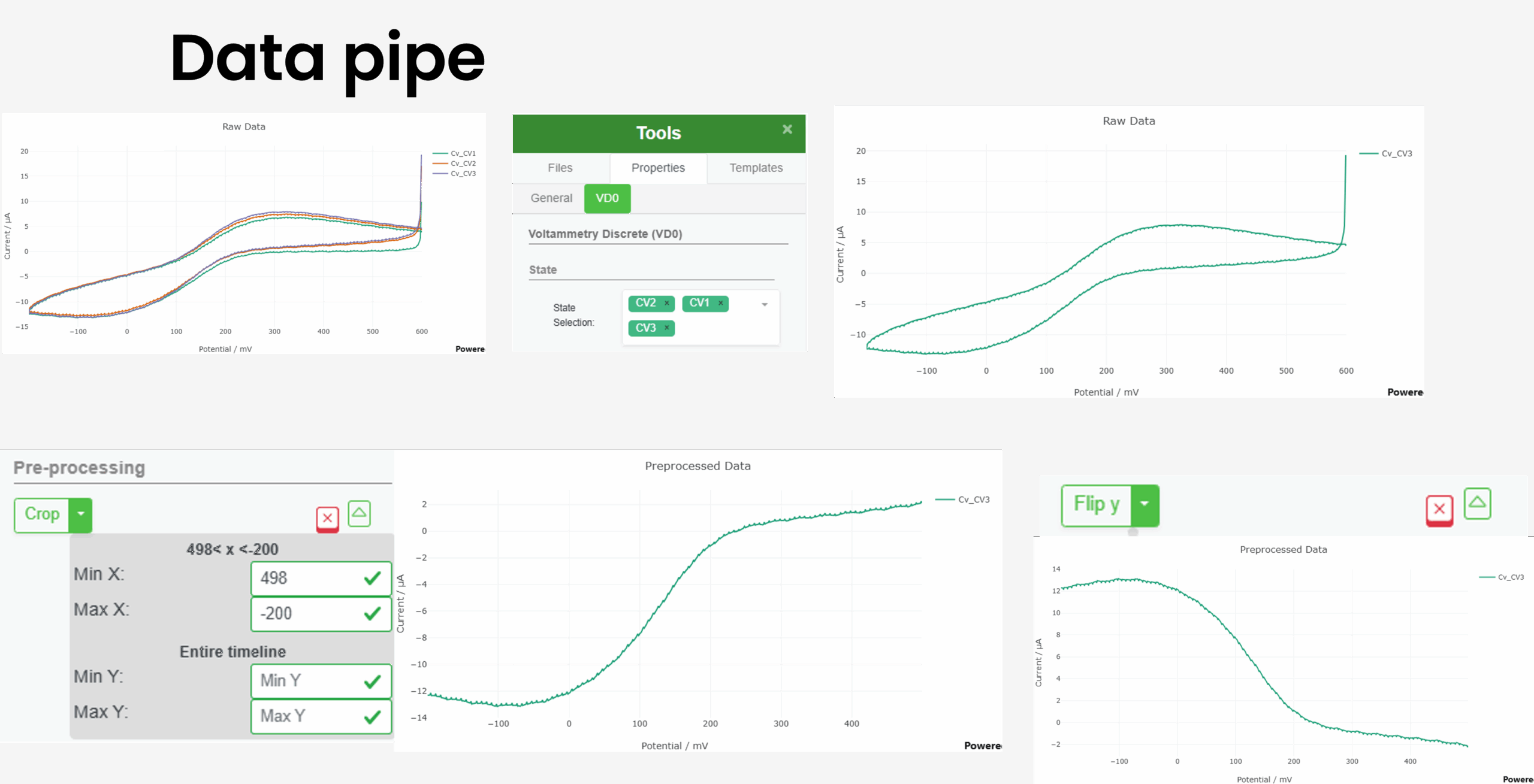
The key is building a robust, automated "data pipe" that handles cropping, baseline correction, and peak finding to deliver that final answer without the user needing a PhD in electrochemistry.
Live Demo Highlights: From Theory to Real-World Results
A series of live experiments were performed, moving from textbook solutions to messy, real-world samples.
1. Cyclic Voltammetry (CV) Made Practical
Experiment: A classic CV of a 5 mM ferricyanide solution using a high-quality carbon screen-printed electrode.
The Twist: Instead of just showing the wave, the host used the Djuli cloud platform to process the data live. He cropped, flipped, and baseline-corrected the CV, turning it into a clean peak. He then automatically found the peak height and applied a calibration factor.
The Result: A calculated concentration of ~5.7 mM, accurately close to the known 5 mM value, demonstrating the repeatability of quality electrodes.
2. Tackling Real-World Samples: Tabasco Sauce
Challenge: Electrochemistry excels with "dirty" samples that would foul optical systems.
Experiment: A diluted sample of Tabasco sauce was tested using a pre-programmed "Chili" protocol, triggered simply by scanning a QR code.
The Result: The Djuli system automatically analyzed the CV data and output a result in Scoville Heat Units (SHU). The calculated 2130 SHU is a verifiably accurate result for Tabasco, proving the practicality of the approach.
3. The Power of Square Wave Voltammetry (SWV) & Red Bull
Technique: SWV is a highly sensitive pulse technique that subtracts non-specific background current.
Experiment: The host ran a fast SWV scan (~18 seconds) on ferricyanide and then on a diluted sample of Red Bull using a "Caffeine" protocol.
The Result: The Djuli platform instantly processed the data and reported a caffeine concentration of 0.311 mg/g, which matches the known value of 0.3 mg/g for Red Bull. This highlights the critical importance of electrode repeatability for reliable results.
4. Open Circuit Potentiometry (OCP)
Experiment: The host measured the OCP of a buffer and then spiked in ferricyanide, causing a clear potential shift.
Data Processing: Using a "delta fit" tool in the Djuli software, the change in potential was calculated and converted directly into a concentration, demonstrating another path from a complex signal to a simple number.
Key Takeaways for Developers and Researchers
Speed is a Feature: A core design principle should be assay speed. No one wants to wait minutes for a result. Techniques should be optimized for velocity without sacrificing accuracy.
Electrode Quality is Everything: The webinar proved that highly repeatable screen-printed electrodes are non-negotiable. Inconsistent electrodes are the biggest barrier to developing reliable, commercial-grade assays.
Technique Choice Matters: While CV is a great teaching tool, techniques like Square Wave Voltammetry (SWV), Differential Pulse Voltammetry (DPV), and EIS are often superior for analytical applications due to their sensitivity and background rejection.
Automate the Data Pipeline: The future of sensing lies in automating the entire journey from measurement to result. The end goal is to hide the complexity and deliver a clear, actionable answer.
Conclusion: Turning Theory into Practice
The webinar illustrated a powerful modern approach to electrochemistry. By combining robust hardware, highly repeatable sensors, and intelligent, cloud-based data processing via Djuli, it's possible to move seamlessly from academic theory to practical, real-world solutions.
Want to see the demos for yourself? A recording of the full webinar is available upon request!