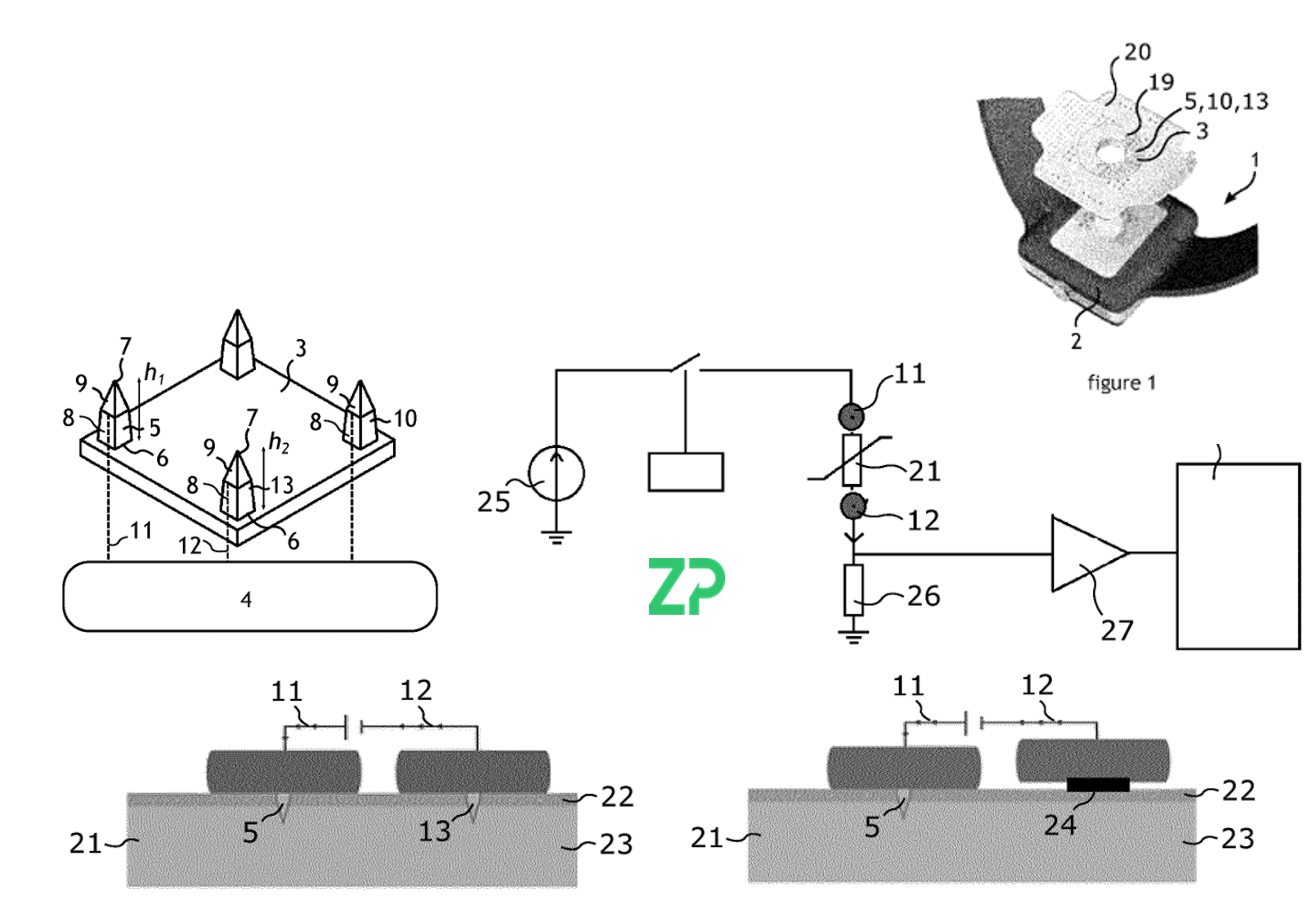
For wearable microneedle sensors, accuracy starts with a deceptively simple question: are the microneedles actually in the right layer of skin? Too shallow, and the device measures sweat or surface effects. Too deep or poorly seated, and signals drift, reliability drops, and user trust is lost. One of ZP’s key patents directly solves this problem—and forms a foundational layer of its wearable microneedle IP moat.
This invention protects a self-verifying microneedle system that continuously confirms correct insertion by measuring the electrical conductivity of the tissue surrounding the microneedles. Because the dermis conducts electricity far better than the outer skin layers, the device can reliably determine—within milliseconds—whether the microneedles have reached the interstitial fluid where meaningful biomarker measurements occur. If insertion is insufficient, disturbed, or compromised by sweat, the system detects it immediately.
Crucially, this verification is built directly into the microneedles themselves. Dedicated conductive microneedles and skin-contact electrodes work alongside the sensing needles, allowing the device to distinguish true interstitial measurements from surface artefacts and even adapt thresholds to individual skin properties. The result is a wearable platform that knows when its data can be trusted, without user intervention.
Within ZP’s broader portfolio, this patent complements IP covering microneedle geometry, surface chemistry, analyte sensing, signal processing, adhesion, modular capsules, and continuous wear. Together, these inventions protect not just how biomarkers are measured, but how wearable microneedle systems remain accurate, stable, and clinically meaningful over time.
For partners collaborating with ZP, this capability represents more than a technical feature—it is part of a system-level IP moat that de-risks real-world deployment. By ensuring microneedles are correctly positioned before and during measurement, ZP enables continuous, reliable monitoring that stands up outside the lab and in everyday life.