High-performance wearable microneedles do not start with sensing chemistry—they start with how precisely and reproducibly the microneedles themselves are made. One of ZP’s core patents protects a manufacturing breakthrough that underpins the entire wearable microneedle platform by enabling ultra-slender, mechanically robust microneedles produced at industrial scale.
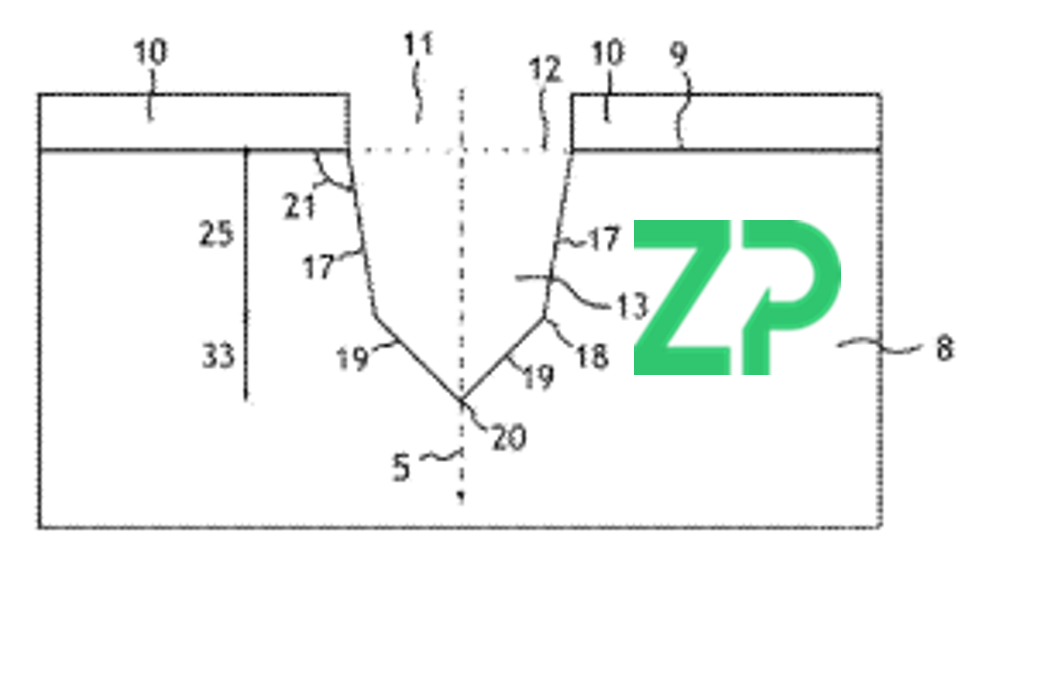
This patent covers a novel way of sculpting deep, high-aspect-ratio structures in single-crystal silicon—the material used to form ZP’s solid microneedles. Rather than relying on a single etching technique, ZP combines deep dry etching with crystal-aware wet etching, using carefully designed mask geometries to precisely control both the shape and the surface quality of the microneedles.
The key insight is counterintuitive: the opening used to etch the silicon is not the same shape as the microneedle you end up with. By using specially designed “compensation patterns” in the etching mask, ZP can reliably produce microneedles with square or rectangular cross-sections, sharp tips, and flat, well-defined faces—geometries that are exceptionally difficult to achieve using conventional methods. These flat faces are critical for applying uniform insulating layers, conductive coatings, and enzyme chemistries used in electrochemical sensing.
The result is microneedles that are long enough to reach interstitial fluid, thin enough to minimise pain, and consistent enough to manufacture by the thousands on a single wafer. Aspect ratios exceeding 10—and even 15—can be achieved while maintaining tight control over insertion depth and mechanical strength. This directly translates into better user comfort, higher signal reliability, and improved product yields.
Within ZP’s broader wearable microneedle portfolio, this patent anchors the manufacturing IP layer, complementing other patents that protect microneedle insertion mechanics, biochemical tuning, dynamic range extension, electrical connectivity, skin adaptation, and data fusion. Together, these inventions form a system-level IP moat that protects not just what ZP measures, but how ZP can reliably build wearable microneedle systems at scale.
For partners collaborating with ZP, this capability removes a major hidden risk in microneedle development: manufacturability. By locking down the process that makes high-quality microneedles feasible in real products, ZP offers collaborations backed by a deep, defensible IP moat that spans from silicon fabrication all the way to continuous, real-world physiological monitoring.