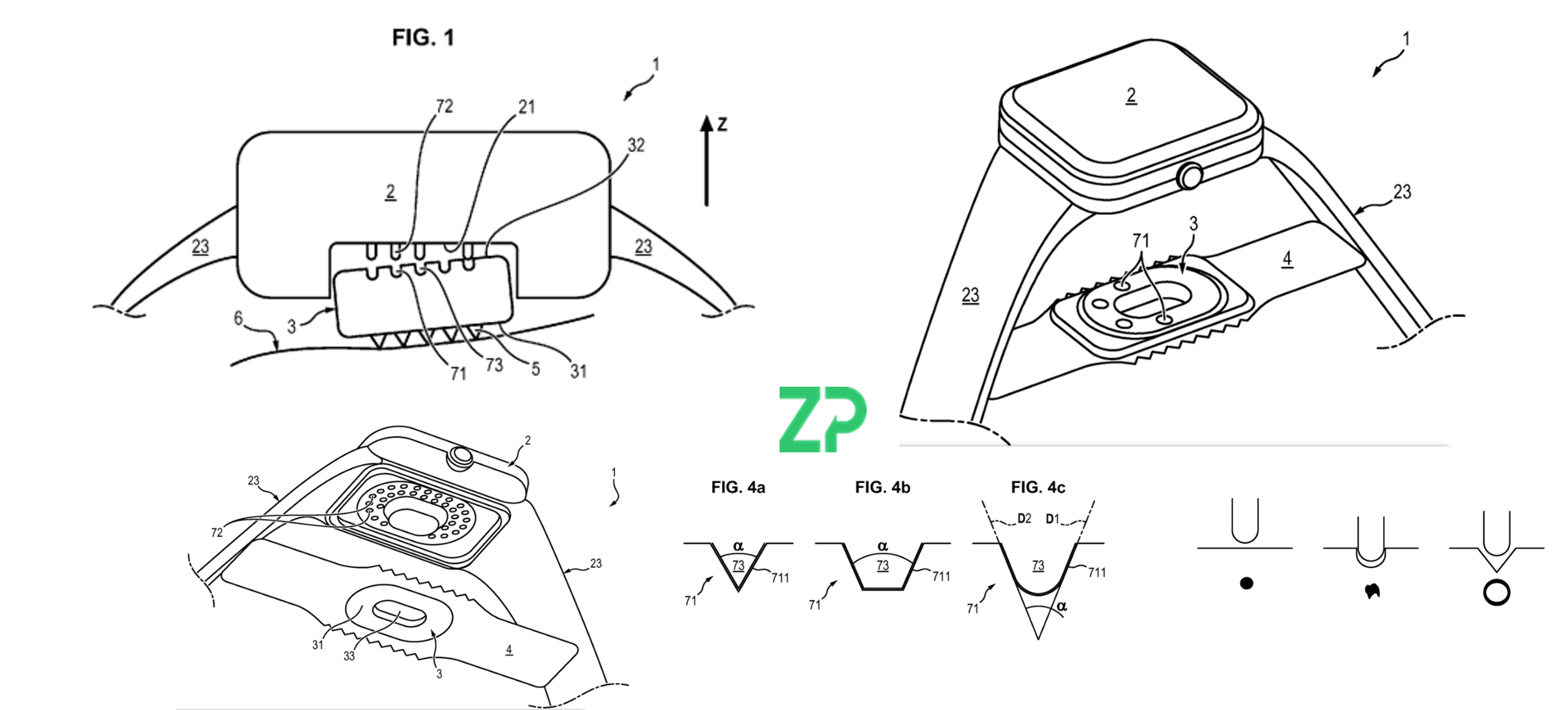
In wearable microneedle systems, accuracy is not just about chemistry or needle design—it also depends on whether clean electrical signals can be maintained while the body moves. WO 2022/214770 protects a core ZP innovation that ensures stable electrical contact between the wearable electronics and the microneedle sensor, even under motion, uneven skin contact, and day-to-day wear.
The patent addresses a subtle but critical problem: when a microneedle sensor is worn on the wrist, small differences in skin curvature, microneedle penetration depth, and wrist movement can cause tiny relative movements between the sensor and the electronics housing. In conventional designs, these micro-movements can interrupt electrical contact, introducing noise, signal dropouts, or measurement drift.
ZP’s solution is elegantly simple and highly effective. Instead of flat electrical contacts, the sensor incorporates concave receiving contacts—shaped like shallow cones or spherical cups—into which spring-loaded or flexible male connectors from the electronics housing engage. This geometry maximises the contact surface area and maintains electrical continuity even when parts move slightly relative to one another. In effect, the connector design actively compensates for motion, pressure variations, and skin dynamics.
This approach delivers a more robust, self-aligning electrical interface that tolerates misalignment, uneven loading, and repeated attachment cycles. It is particularly well suited to removable sensor capsules, long-wear patches, and watch-like devices—exactly the architectures ZP uses for continuous interstitial fluid monitoring with microneedles.
Within ZP’s broader wearable microneedle IP portfolio, this patent strengthens the system-integration layer of the IP moat. It complements patents covering microneedle fabrication, skin insertion, biochemical sensing, moisture management, mechanical compliance, and manufacturing scalability. Together, these layers protect not just individual components, but the end-to-end reliability of a wearable microneedle platform operating on real, moving human skin.
For partners and collaborators, this matters because electrical reliability is often a hidden failure mode in wearables. By locking down this interface at the IP level, ZP enables collaborations that benefit from cleaner signals, fewer artefacts, longer wear times, and higher confidence in continuous data, all backed by a defensible, system-level patent moat.