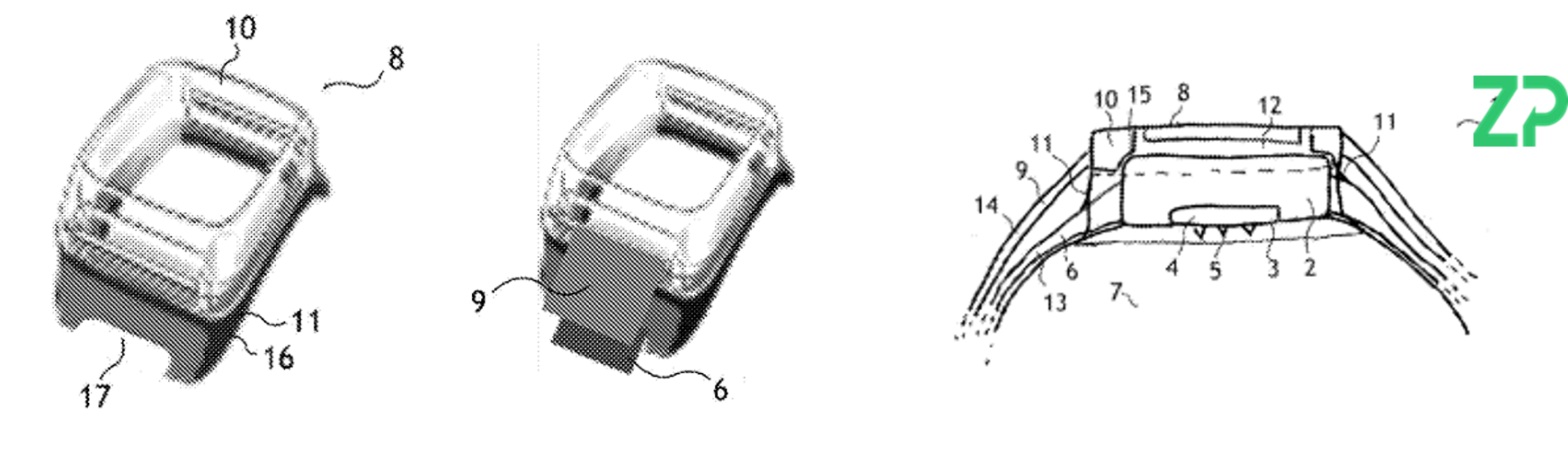
In wearable microneedle devices, accuracy depends not only on the sensor itself, but on the quality of the physical and electrical connection between the sensor and the wearable electronics. One of ZP’s patented innovations addresses this critical but often underestimated challenge, reinforcing ZP’s wearable microneedle IP moat at the interface between skin, sensor, and device.
This patent protects a smart way of connecting a removable microneedle sensor to a wearable housing using spring-loaded electrical contacts. These contacts ensure reliable electrical transmission even as the wrist moves, the skin flexes, or the strap tension changes during daily wear. However, spring contacts naturally push components apart—so ZP’s invention goes further, engineering the geometry and placement of the connectors themselves to maintain stable contact.
The key insight is how the connectors are distributed. Rather than clustering contacts in one area, the invention specifies a balanced, symmetrical layout around the centre of the wearable, aligned with the main force applied by the strap. By ensuring that most connectors are evenly spread across this zone, the forces from the springs are mechanically compensated by the strap pressure. The result is a connection that remains stable, low-noise, and reliable—even with imperfect tightening or natural wrist motion.
This architecture allows ZP to use multiple redundant contacts, improving signal quality and robustness without increasing user burden. It also supports modular designs where the sensor capsule can be detached and replaced while leaving adhesive patches on the skin—an important feature for long-term, continuous monitoring.
Within ZP’s broader wearable microneedle portfolio, this patent complements IP covering microneedle insertion, adhesion, sensor preparation, calibration, fit control, and manufacturing precision. Together, these inventions protect not just how biomarkers are measured, but how wearable microneedle systems survive real-world use without signal degradation.
For partners collaborating with ZP, this technology is part of a system-level IP moat that removes mechanical uncertainty from continuous sensing. By engineering reliability directly into the connector layout, ZP ensures that high-quality data is maintained—not just in controlled conditions, but in everyday life.