Accurate continuous monitoring is not just about putting sensors under the skin—it is about maintaining signal quality across the full range of real physiological conditions. One of the persistent challenges in electrochemical microneedle sensing is that no single measurement mode performs optimally at both low and high analyte concentrations. WO 2021/144472 A1 addresses this challenge at a system level, adding an important layer to ZP’s wearable microneedle IP moat.
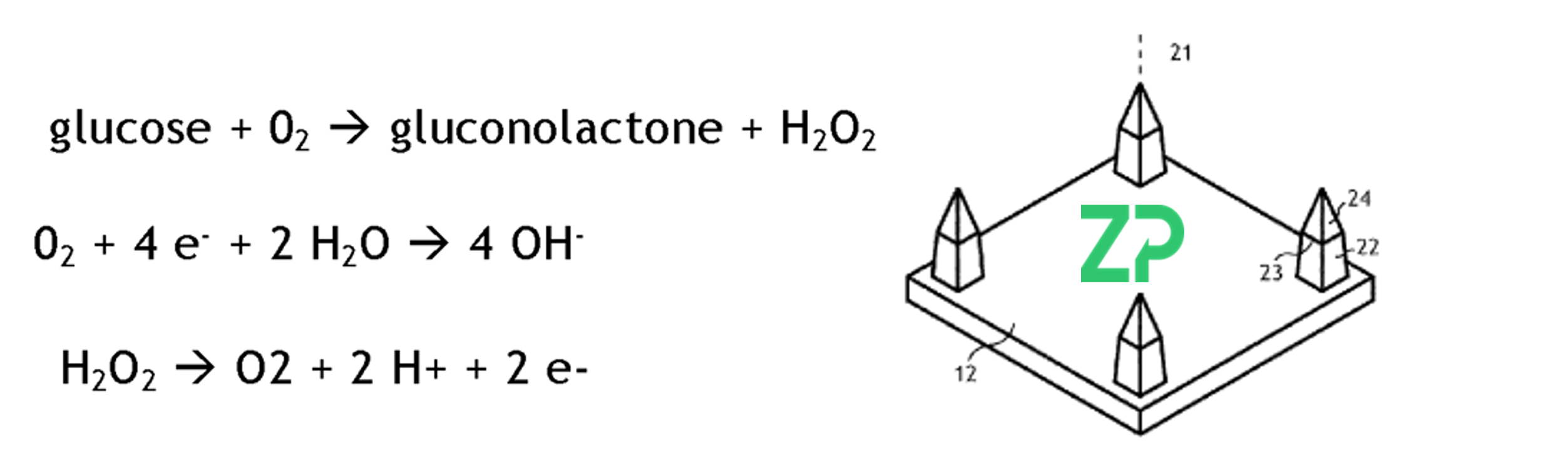
This patent protects a dynamic measurement method that automatically switches how a microneedle sensor operates depending on the analyte concentration being measured. By intelligently adjusting the electrical potential applied to enzyme- and mediator-coated microneedle electrodes, the system selects the most reliable electrochemical pathway at any given moment. At low concentrations, it prioritizes low-noise measurements that suppress interference from compounds such as vitamin C or uric acid. At higher concentrations—where conventional mediator systems can saturate—it switches to a different operating mode that preserves linearity and accuracy.
Crucially, this switching happens within the same wearable device, without user intervention, and is compatible with short, painless microneedles that access interstitial fluid while avoiding nerves and blood vessels. The result is a sensor that maintains accuracy across hypoglycaemic, normal, and hyperglycaemic ranges, enabling true continuous monitoring rather than a narrow operating window.
Within ZP’s broader portfolio, this patent complements IP covering microneedle geometry, surface chemistry, modular capsules, adhesion, repositioning, and continuous power. Together, these inventions protect not just individual sensor components, but the complete sensing strategy—from how analytes are accessed, to how signals are generated, stabilised, and interpreted over time.
For partners working with ZP, this translates into a powerful competitive advantage: access to a system-level IP moat that enables robust, clinically meaningful data in real-world wearable applications. It is another example of how ZP’s microneedle patents are designed not in isolation, but as interoperable building blocks for next-generation wearable biosensing platforms.