Square wave voltammetry (SWV) is a sensitive way to measure a chemical with an electrode. Instead of sweeping the potential smoothly, it steps up a staircase while adding a small square wave on top: a forward pulse, then a reverse pulse, at every step. The current is measured at the end of each pulse, and the difference between the two – the difference current, Δi – produces a clean peak that stands out from the background.
We use SWV with our screen-printed electrodes, on everything from test solutions to real samples such as drinks. A common question is why the peak appears where it does. This simulator shows the answer.
How to use it: press Play scan to sweep the staircase potential, or drag the slider yourself. Watch the green (forward) and navy (reverse) pulses move along the curve on the left, and the peak build on the right. Change the amplitude to see the peak grow taller and wider, and tick Slow kinetics to see why a slower electrode gives a broader, shifted peak.
Why the square wave peak sits at E°′
The Nernst equation fixes the ratio of oxidised (O) to reduced (R) species at the electrode surface. Each forward pulse pushes the surface towards O; each reverse pulse pulls it back towards R. The swing is largest at the formal potential, E°′, which is where the peak appears.
Near E°′: each forward pulse oxidises R to O and each reverse pulse reduces O back to R, so the surface composition swings the most and Δi is largest.
Schematic, n = 1, 25 °C, 25 mV amplitude. Real Δi also depends on diffusion; the slow-kinetics option is illustrative only.
Try it yourself
Everything in this simulator can be measured for real with a potentiostat and a screen-printed electrode. A single drop of sample on the electrode is enough to run square wave voltammetry in under a minute.
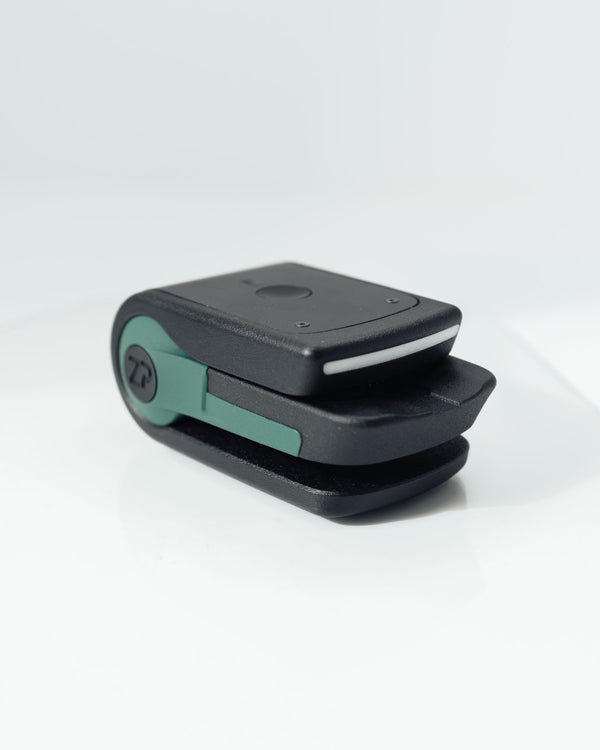
 SenseitAll (SIA) potentiostatA hardware platform for teaching, research and prototyping your own sensor ideas.View the instrument →
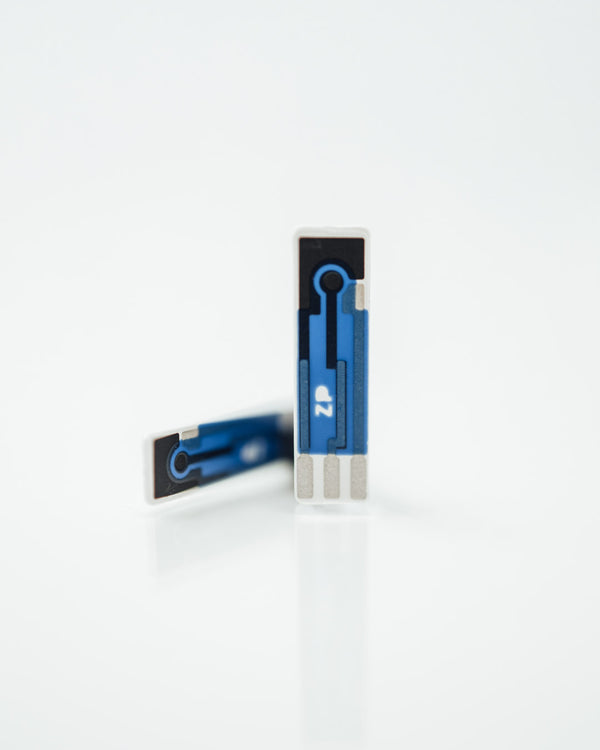
 Screen-printed electrodesCarbon, gold, platinum and silver/silver chloride electrodes, including the ZP 501 carbon electrode.Browse electrodes →
Try it on your own bench
Everything you need to run square wave voltammetry yourself – a potentiostat and a screen-printed electrode – is available from our webstore.
Show the numbers behind the peak
| Staircase potential (E − E°′) | Swing in surface composition per pulse cycle |
|---|---|
| −200 mV | 0 % |
| −100 mV | 4 % |
| −50 mV | 22 % |
| 0 mV | 45 % |
| +50 mV | 22 % |
| +100 mV | 4 % |
| +200 mV | 0 % |

