Stop Reinventing the Wheel: Find Your First 10 Paying Customers Instead
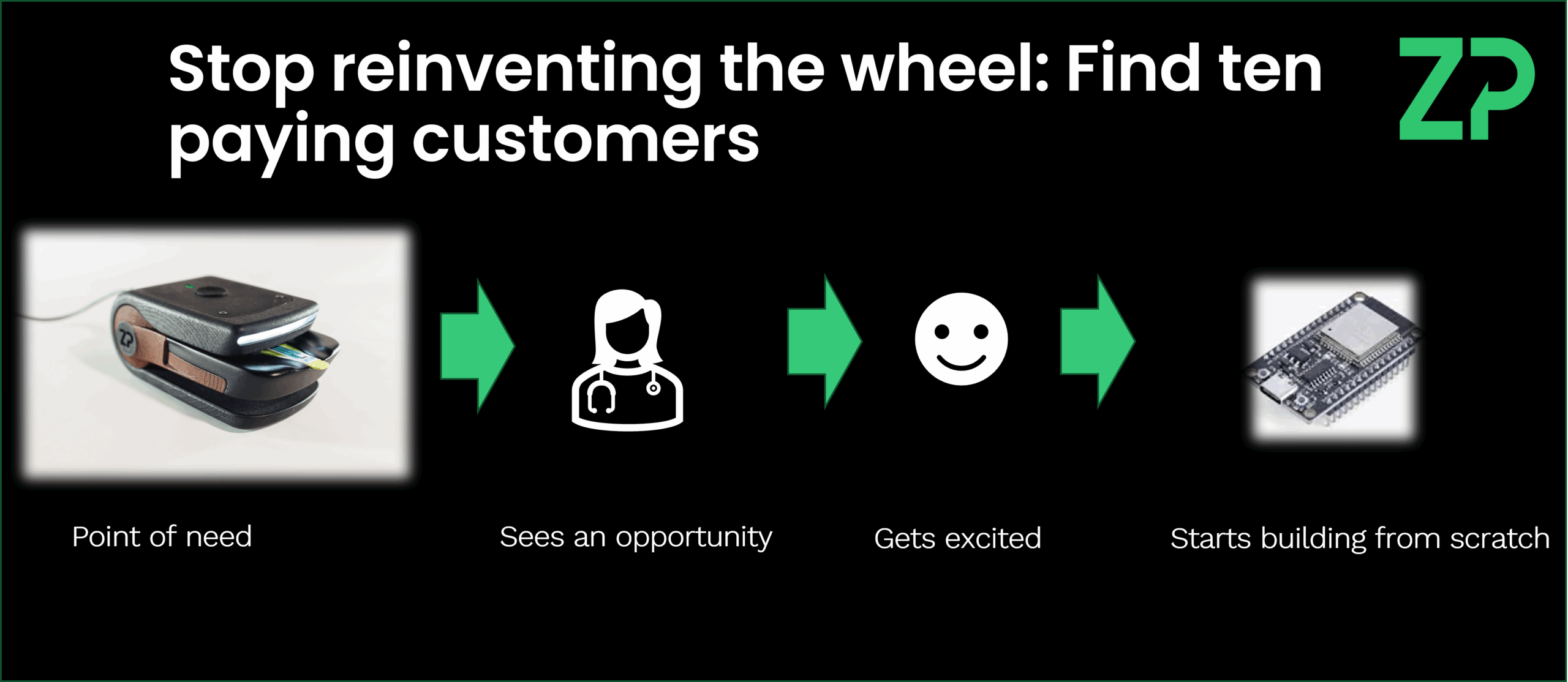
We’ve all heard the phrase, “Don’t reinvent the wheel.” It’s not a criticism; it’s a call for efficiency. Yet, in the world of point-of-need and point-of-care development—a space that’s rapidly expanding with technologies like AI—a common and costly phenomenon persists: teams rush to build entirely new technology stacks from the ground up.
If you have a product idea for decentralized testing, whether in medical diagnostics, environmental monitoring, or AI-driven field analysis, your first instinct might be to start prototyping new hardware. But I’d argue there’s a better, more effective strategy.
The best strategy for commercialization isn't building a full supply chain—it's finding your first 10 paying customers.
Let’s break down why.
The "Unique Requirements" Fallacy
The journey often starts with excitement. You see an opportunity in decentralized testing and immediately begin designing custom hardware, perhaps a complex "lab-on-a-chip" with microfluidics, pumps, and valves.
When presented with existing, off-the-shelf platforms that could accelerate this process, the justification for forging ahead alone often boils down to three fallacies:
"My requirements are unique." (e.g., "I need to detect multiple analytes.") The truth is, most requirements aren’t as unique as we think. Multiple analytes? That’s a common challenge, not a unique imperative that justifies a multi-year R&D project.
"I need extreme complexity." Complexity is often the enemy of commercializability. A simpler, proven solution that gets you to market is almost always better than a complex, bespoke one that never ships.
"The unit cost is too high." Judging a development platform by its single-unit price is a critical error. The time and capital required to design, manufacture, and quality-control your own version will dwarf the cost of leveraging a pre-built, scalable solution. You can’t build a $50 product without first proving there’s a market for it—a process that requires a significant upfront investment in manufacturing you likely don’t have yet.
These fallacies are mental tricks we use to justify reinventing the wheel. The real challenge isn’t technical—it’s commercial.
The Myth of the "Full Business"
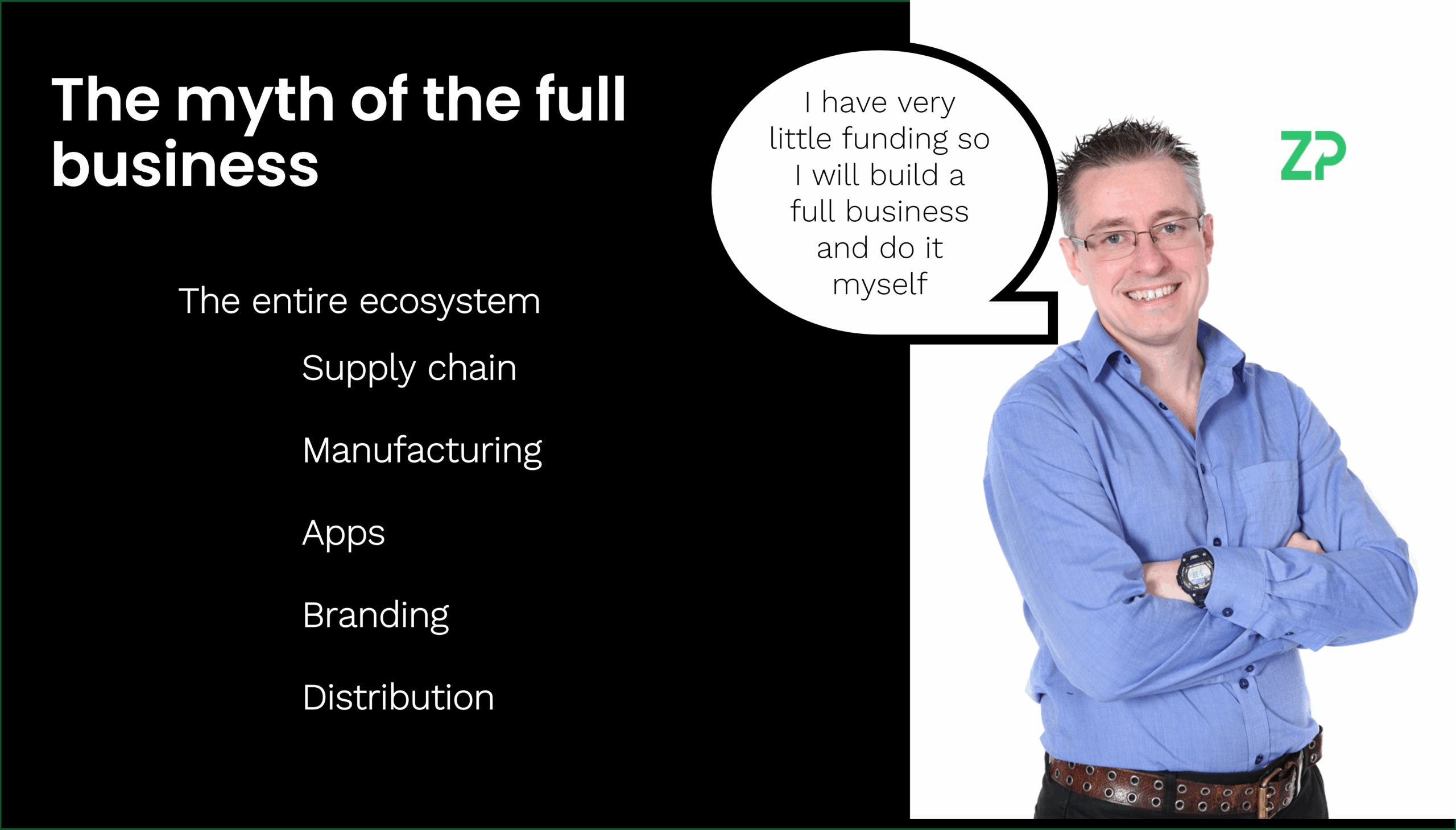
There’s a pervasive myth that to find your first customer, you need the entire business ecosystem already in place:
A finalized product
A scaled supply chain
Full manufacturing
Branding and logos
Distribution channels
Polished mobile apps
This is the "Myth of the Full Business." You don’t need any of this to start validating your idea. In fact, building it all first is a fantastic way to waste time and money.
I often hear two other justifications that ring alarm bells:
"We have little funding, so we have to build it ourselves." This is flawed logic. Building a full business is the opposite of a low-cost strategy. A lack of funding should make you more focused on lean validation, not less.
"We’ve done market surveys." Market surveys are a relic from an era before Minimal Viable Products (MVPs) and rapid prototyping. They are notoriously unreliable. People are nice; they’ll tell you your idea is great when their money isn’t on the line. As Steve Jobs famously demonstrated, people often don’t know what they want until you show it to them. A survey is no substitute for a real-world transaction.
The Power of 10 Paying Customers
So, if you don’t need a full business, what do you need? Your first 10 paying customers.
This isn’t just about the revenue. The value of those first 10 customers is immense:
Real Validation: They prove you’ve identified a problem worth solving.
Real Feedback: Their input is more valuable than a thousand market surveys. They’ll tell you what actually works and what doesn’t.
A Defined Customer Profile: You learn exactly who your early adopter is—their needs, their frustrations, their workflow.
True Price Discovery: You learn what the market is willing to pay today. (Hint: Early adopters will pay more than the majority later on).
A Better Story: A pitch deck that says "We have 10 paying customers" is infinitely more powerful to investors than one that says "We have a great technology and a team." It transforms your story from "please believe in us" to "help us scale what already works."
A Word of Caution on Government Grants
Be careful with public funding. While non-dilutive capital seems attractive, the goals of government grants (job creation) can be misaligned with the goals of an entrepreneur (validating product-market fit). Don’t mistake a grant for market validation. The best investors are always paying customers.
How To Stop Reinventing the Wheel: A Real-World Example
At Zimmer and Peacock, we built the SenseItAll (SIA) platform for this exact reason. We’ve spent over a decade building a complete technology stack so you don’t have to.
Our platform includes:
Manufacturable Electrodes: For a wide range of analytes.
User-Friendly Potentiostat Hardware: A professional, phone-connected device.
Ready-to-Use Mobile Apps: Already available on iOS and Android app stores.
Cloud Data Processing (Julie): Instantly processes raw data, performs feature extraction, and returns clear results.
During the video, I demonstrated this by running a caffeine assay. In under a minute, I:
Prepared a sample.
Placed a sensor into the SenseItAll (SIA) reader.
Scanned a QR code to tell the app what to do.
Ran the test using Square Wave Voltammetry.
Received a clear, quantitative result (0.429 mM) on my phone.
The raw data was simultaneously sent to our cloud system, providing full transparency for debugging and support—a crucial feature when iterating with your first customers.
This entire stack exists so you can focus on developing your assay and, most importantly, finding your first 10 paying customers instead of rebuilding the underlying technology.
Summary: Your Path Forward
Acknowledge the Fallacy: Your requirements are likely less unique than you think. Challenge your own assumptions.
Kill the Myth: You do not need a "full business" to start. You need validation.
Focus on Commerce, Not Technical R&D: Your primary goal is to find people who will pay for your solution.
Find 10 Paying Customers: This is your most important milestone. It de-risks your idea and creates a powerful foundation for growth.
Leverage Existing Stacks: Use platforms like SenseItAll (SIA) to get a tangible, working product in front of customers now, not years from now.
Stop reinventing the wheel. Start finding your customers.
If this philosophy resonates with you and you're working on a point-of-need application, we’d love to hear from you. Let's talk about how you can get to your first 10 customers faster.